
Last updated September 22, 2026
Free on-site gate assessment - hinges, posts, and your LiftMaster or Nice gate operator checked before anything is quoted
The assessment is free and the quote is the invoice.

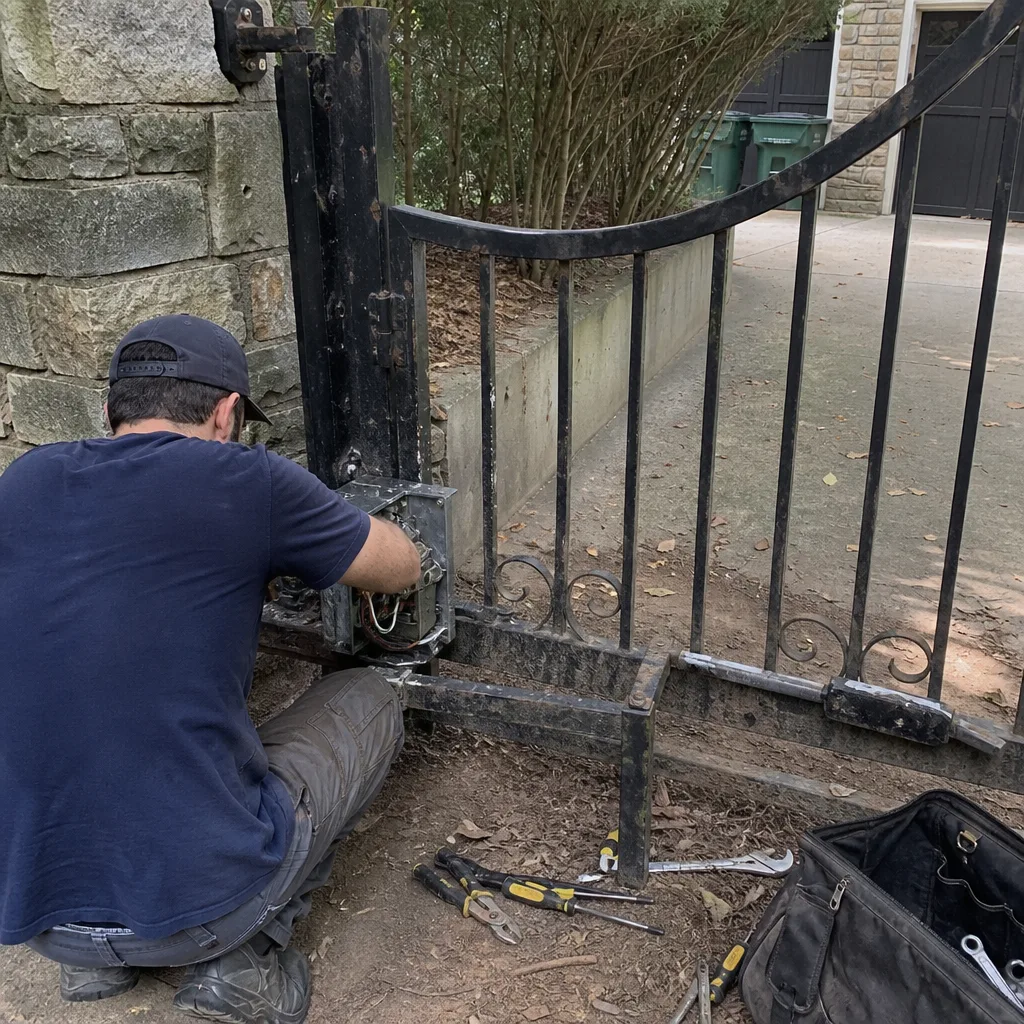 Before
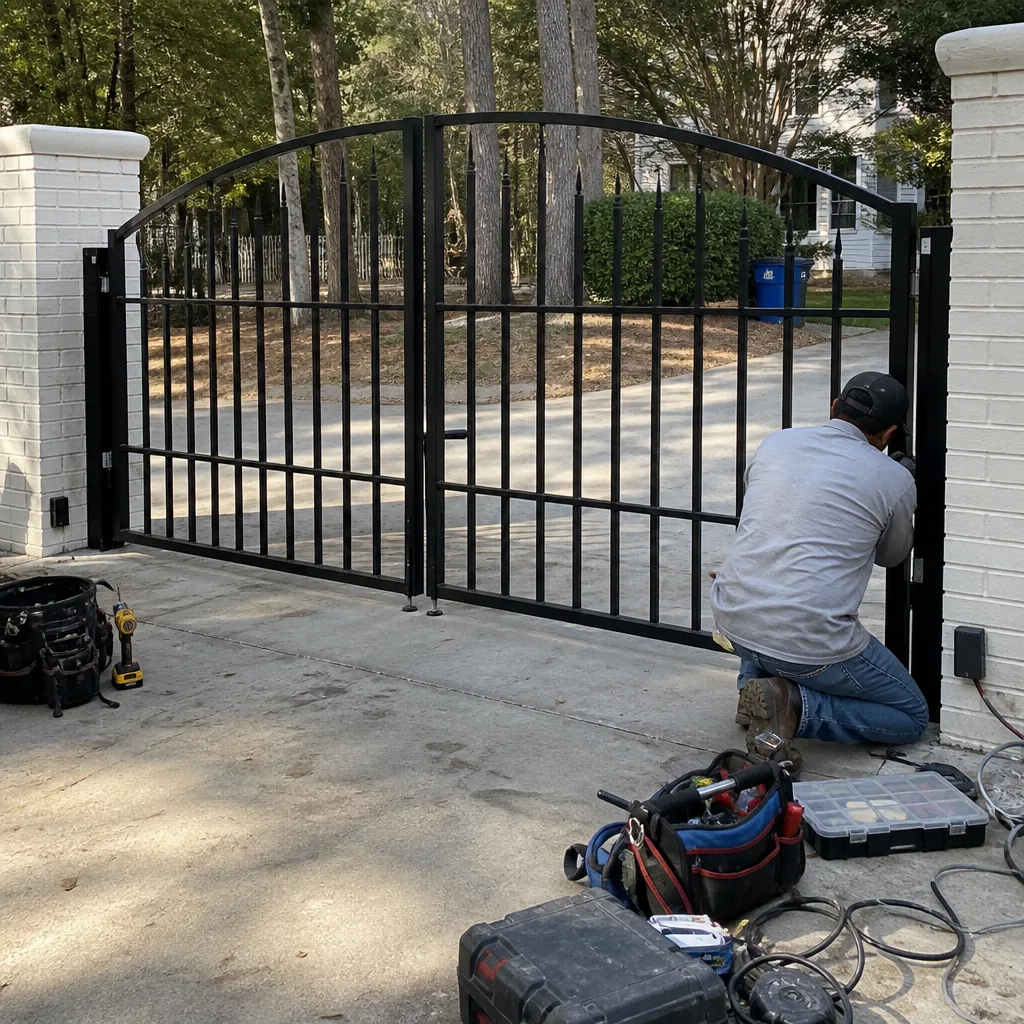 After
After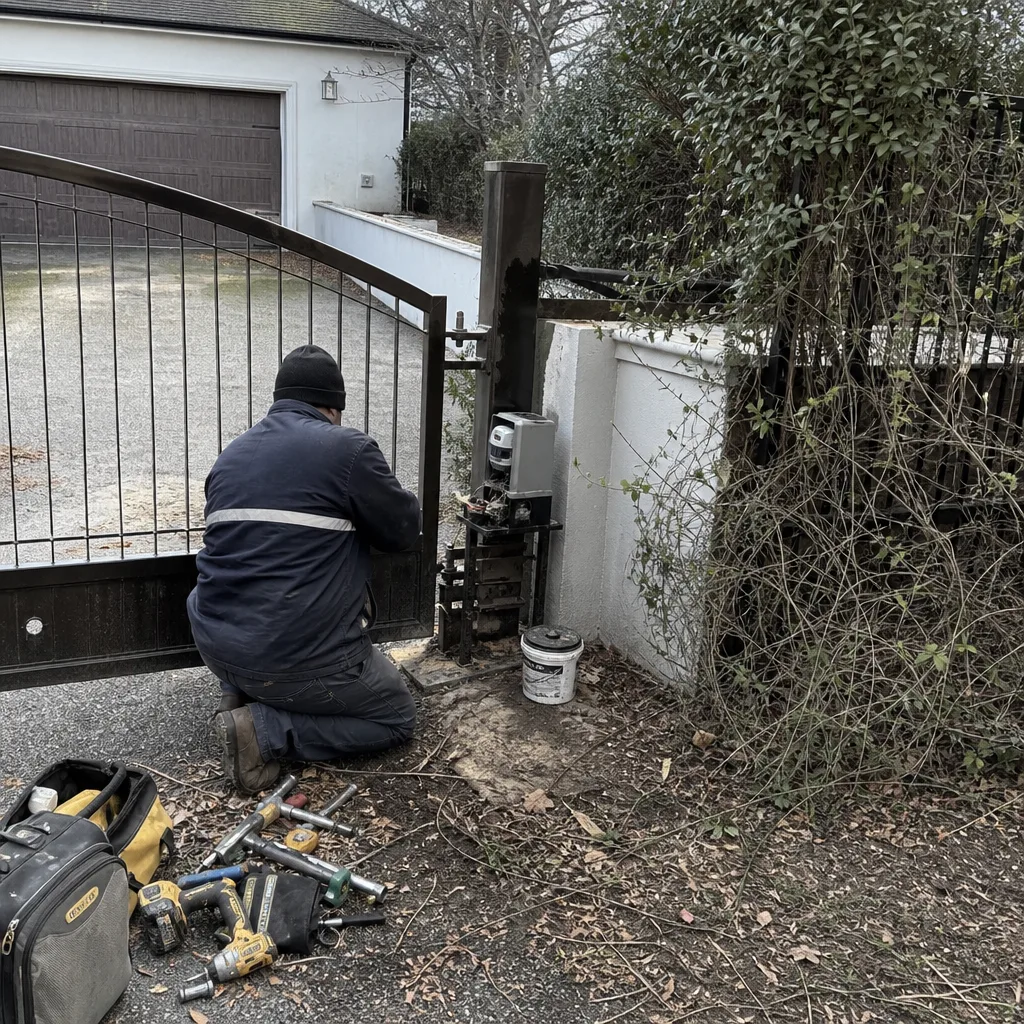 Before
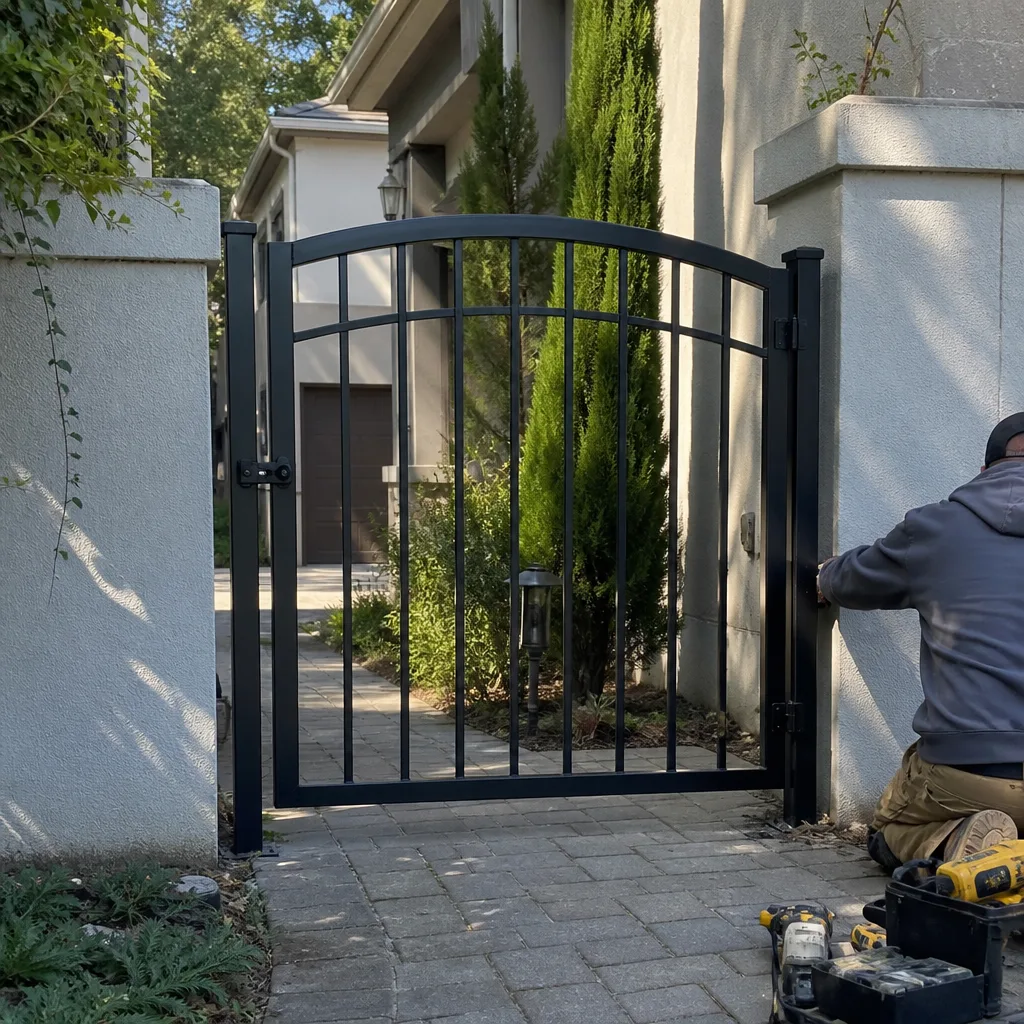 After
After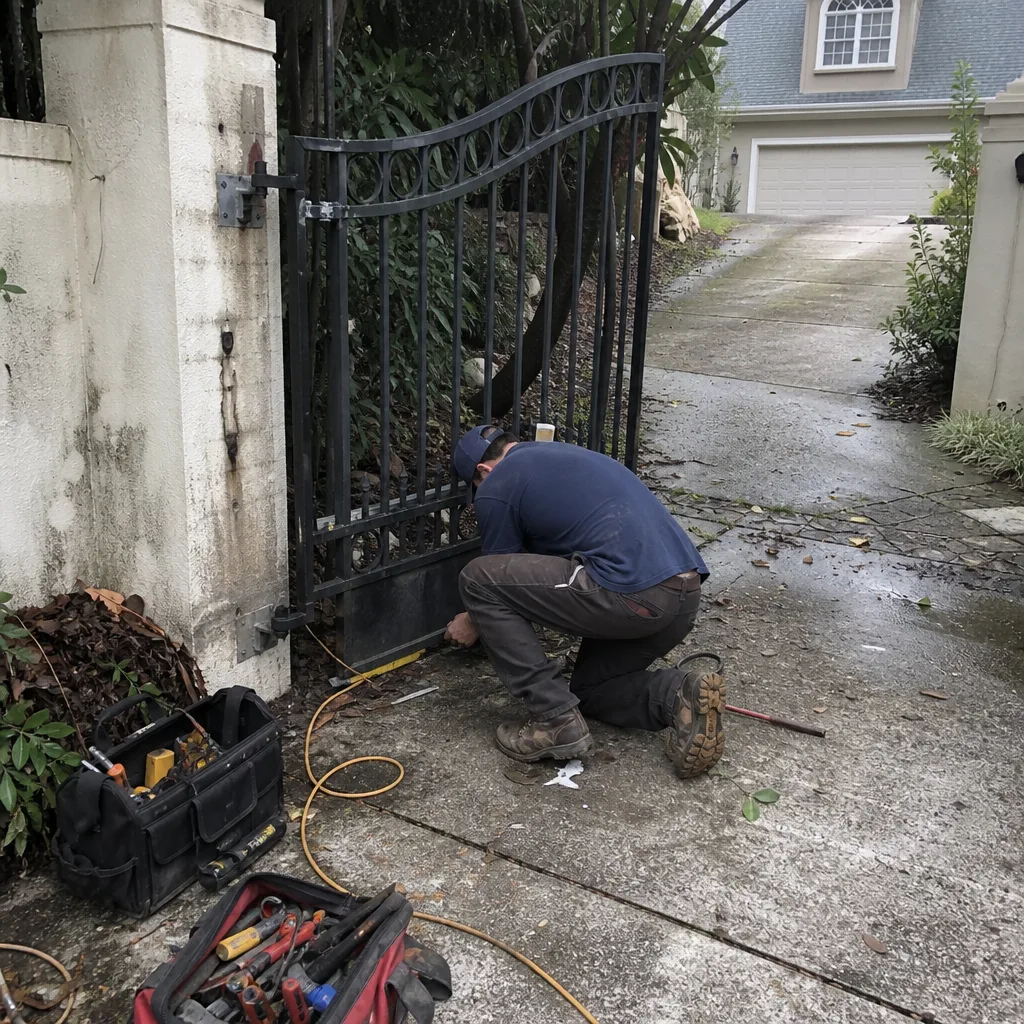 Before
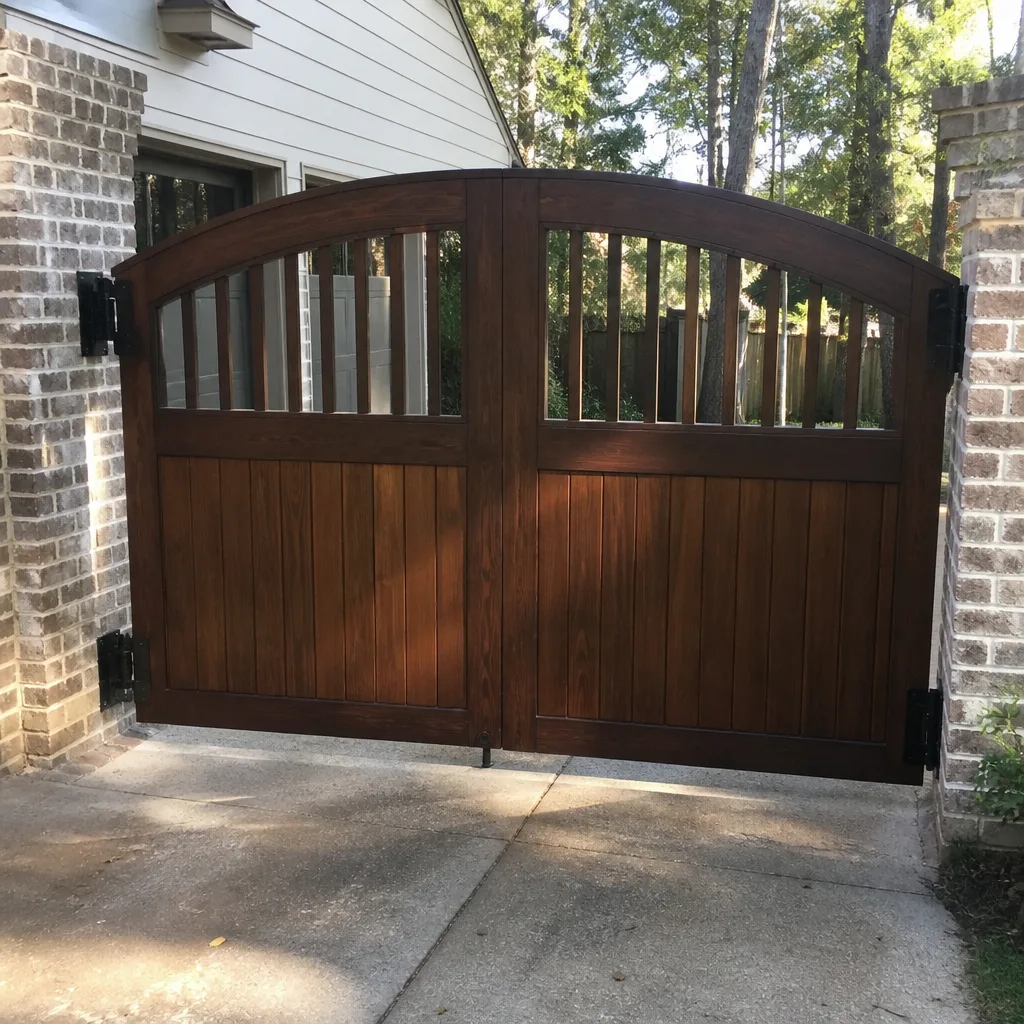 After
AfterGate Repair Warning Signs: A Sandy Springs Homeowner’s Reference Guide
A gate that hesitates for two seconds before moving isn’t “working fine, just slow.” That pause is the operator drawing extra current against a mechanical load it shouldn’t be carrying, and it’s leaving a measurable record on the circuit board that confirms exactly how close to failure it is. In Sandy Springs, where steep driveways off Riverside Drive and the hilly lots near Dunwoody Club Forest put constant lateral stress on swing-gate hinges, we’ve documented operators pulling 40% more amps than spec months before they burned out. This guide-along with our Seasonal Gate Repair Care for Sandy Springs: Year-Round Homeowner’s Guide-reframes every common symptom as a data point with a predictable timeline, so you know what each sign predicts before you’re stuck with a gate that won’t open or close.
Quick Answer
Gate repair warning signs fall into three categories: immediate-stop indicators (gate reverses randomly, motor hums without movement, visible cable fraying), 30-day warning signs (two-second startup delays, intermittent remote response, new grinding at end of travel), and slow-decay patterns (gradual slowing over months, increasing remote presses needed, post-rain behavior changes). Most Sandy Springs homeowners wait until an immediate-stop indicator appears, but the 30-day and slow-decay signs are where documented early intervention saves 60-70% on Gate Repair services.
Table of Contents
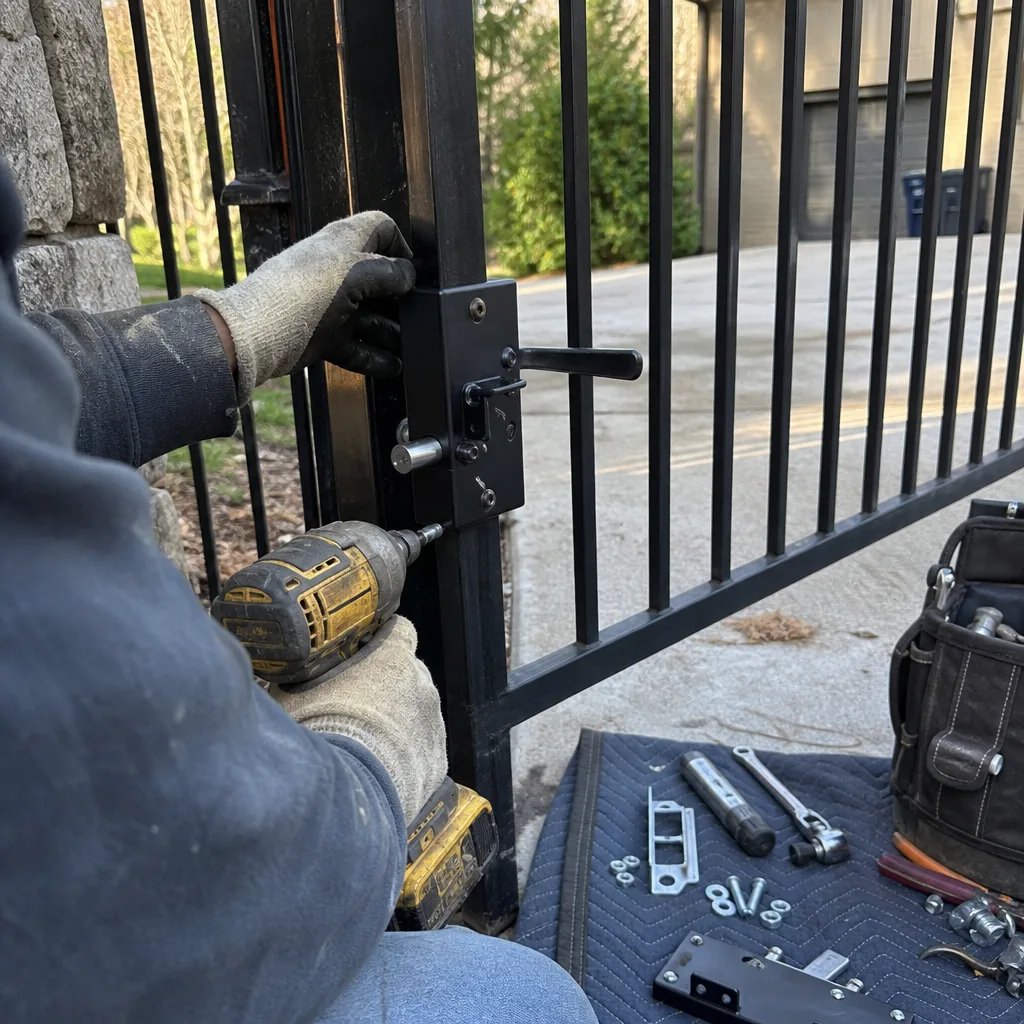
- Immediate-Stop Indicators: When the Gate Needs Repair Today
- 30-Day Warning Signs: The Window for Preventive Repair
- Slow-Decay Patterns: 90 Days of Predictable Decline
- What Specific Sounds Predict: A Diagnostic Guide
- Electrical Problems That Look Mechanical (and Vice Versa)
- What to Photograph and Log Before Calling
- The True Cost of “It’s Still Working”
- Common Mistakes to Avoid
- When to Call a Professional
- Frequently Asked Questions
 Before
 After
AfterImmediate-Stop Indicators: When the Gate Needs Repair Today
These signs mean the gate has crossed from degraded to dangerous, or from functional to non-functional. Continuing to cycle the operator risks motor burnout, control board damage, or structural failure that turns a $280 repair into a $1,400 replacement.
Gate Reverses Without Obstruction
When a gate begins its close cycle, then reverses with nothing in the path, the photo-eye (the infrared beam that stops the gate if something crosses the path) is either misaligned, obscured, or the control board’s obstruction sensitivity has drifted out of spec. In Sandy Springs, we see this frequently after heavy pollen seasons in March and April, when yellow coating builds on the photo-eye lens. But if cleaning doesn’t resolve it, the issue is often limit-switch drift combined with increased motor load. The operator thinks it hit something because the current spike at end-of-travel now exceeds the factory obstruction threshold.
What to check: Look for the LED indicator on each photo-eye. Both should show solid red or green (brand-dependent). A blinking LED means misalignment. On LiftMaster and Elite systems common in Sandy Springs subdivisions, realignment requires a small Phillips screwdriver and patience, but if the eyes were never physically bumped, the problem is deeper. Call before the repeated reversal cycles strip the nylon drive gear.
Motor Hums, Gate Doesn’t Move
This is the classic stripped drive gear or broken shear pin. The motor runs, but the mechanical connection to the gate is severed. On swing gates with Mighty Mule or Ghost Controls operators, we’ve found the shear pin designed to break under overload fatigue-fractured from years of vibration rather than single-event overload. On sliding gates with FAAC or BFT rack-and-pinion systems, the pinion gear strips its teeth one by one until only the motor shaft spins.
Safety note: A humming motor with no movement can overheat and trip thermal protection, or worse, burn the motor windings. Don’t cycle it repeatedly hoping it will “catch.” Disconnect power at the breaker and call for service.
Visible Cable or Chain Fraying
On chain-drive sliding gates, particularly older Linear or DoorKing systems in Sandy Springs commercial and multi-family applications, chain wear is visible if you know to look. A single cracked roller pin or bent link becomes a failure point under load. On residential swing gates with cable-assisted arms, cable fraying near the termination fitting is common where the cable enters the swaged fitting and experiences flex cycling. We’ve replaced cables on gates in the North Springs area where the homeowner noticed three broken strands and waited, only to have the cable part completely with the gate mid-travel.
Gate Detached from Operator Arm
The bracket connecting the operator arm to the gate frame carries the full dynamic load of every open/close cycle. When bolts loosen progressively, the arm develops slop, then hammering, then ovalized holes, then sudden detachment. We’ve documented this progression in photo records from Sandy Springs properties near the Chattahoochee River, where clay soil expansion and contraction from seasonal moisture changes stress gate posts and accelerate hardware loosening.
30-Day Warning Signs: The Window for Preventive Repair
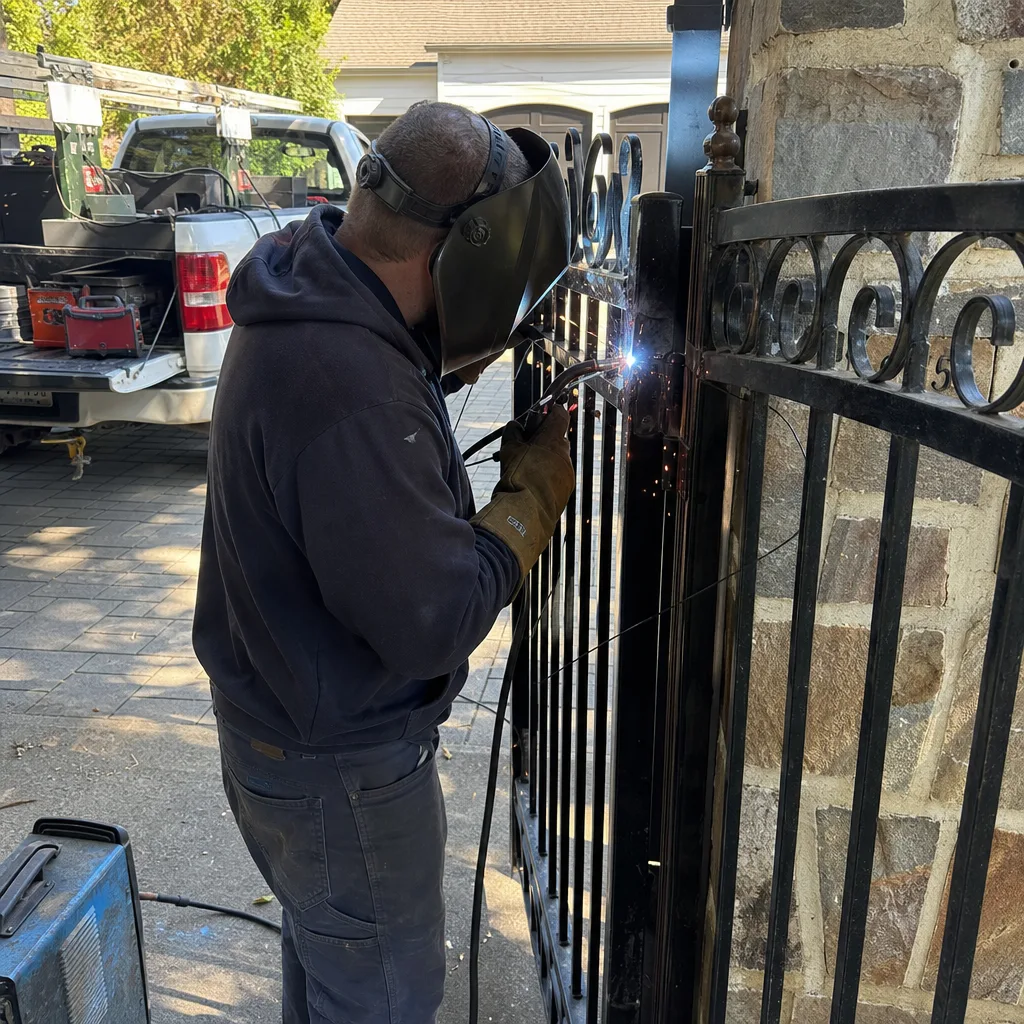
These symptoms predict failure within roughly 30 days of typical use (4-6 cycles daily). Addressing them during this window typically costs $180-$340 versus $800-$1,400 if left to progress.
The Two-Second Startup Delay
As described in the opening, this is not normal. A healthy operator begins moving the gate within 0.5 seconds of command. The extended delay means the motor is fighting static friction, often from dry hinge bearings, a bent gate frame creating binding, or a failing start capacitor in the operator. We measure this with a clamp meter: a healthy FAAC 746 draws 3.2-3.8 amps at startup on a standard aluminum swing gate. When startup current hits 5.5+ amps with delayed movement, the capacitor is degrading or the mechanical load has increased.
In Sandy Springs, we see this pattern frequently on gates installed by builders during the 2005-2010 construction boom, where galvanized steel hinges were specified without grease fittings. After 15+ years of Georgia humidity and temperature cycling, the hinge pins seize progressively. The operator compensates until it can’t.
Intermittent Remote Response
The remote works from 50 feet on Tuesday, requires 15 feet on Thursday, and needs you to stand at the keypad by Saturday. This progression is almost never the remote battery alone. Antenna degradation, control board receiver drift, or increasing motor load causing the operator to ignore secondary commands while completing a high-current cycle are the usual causes. We’ve traced this to failing receiver boards in Viking operators where cold-solder joints from thermal cycling create intermittent connections.
Grinding Sound at End of Travel
A new grinding or growling sound that occurs only in the last 6-12 inches of open or close travel indicates the limit switches are no longer stopping the motor at the correct position. The operator is driving the gate against its physical stops. On screw-drive and rack-and-pinion systems, this strips teeth. On swing gates, it wallows out hinge pins and loosens masonry anchors. The limit switches themselves are often fine; they’ve drifted because the gate’s physical travel has changed (sagging frame, shifting post, bent arm) and the switches were never recalibrated.
Post-Rain Behavior Changes
This is particularly relevant in Sandy Springs, where summer thunderstorms drop 2-3 inches in an hour and clay soils shift dramatically. If your gate operates differently for 24-48 hours after heavy rain, the issue is almost certainly ground movement affecting post plumb, track alignment, or underground conduit integrity. Water intrusion into control boxes is also common when conduit seals fail. We’ve documented cases in the Glenridge area where a single rain event shifted a sliding gate track 3/8 inch, enough to cause intermittent obstruction reversals that cleared when the soil dried and the track settled back.
Slow-Decay Patterns: 90 Days of Predictable Decline
These changes happen gradually enough that homeowners adapt to them. That’s the danger. Each adaptation represents accelerated wear somewhere in the system.
Gradual Slowing Over Months
A gate that took 12 seconds to open in January and now takes 18 seconds in June has a measurable problem. The most common cause is progressive bearing seizure in hinges or rollers, but we’ve also documented this from failing run capacitors in single-phase motors, where reduced capacitance weakens the rotating magnetic field and motor torque drops proportionally. On a LiftMaster CSW200 we serviced in Sandy Springs last year, the run capacitor had drifted from 35 μF to 19 μF over seven years. The gate still opened, but the 16-second cycle time versus the original 12 seconds represented a 33% overload on the motor for every cycle.
Increasing Remote Presses Required
First it was one press. Then two, held slightly longer. Now you stand at the keypad and press deliberately. This progression typically indicates either receiver sensitivity degradation or the operator’s logic board failing to process commands during high-current events. We’ve found that homeowners unconsciously compensate by pressing the remote at closer range, which masks the underlying progression until the range becomes impractical.
Seasonal Performance Variation
Gate works fine October through April, struggles May through September. In Sandy Springs, this pattern strongly suggests thermal issues: control boards with failing capacitors that drift out of spec above 85°F, or motors with degraded insulation that draws excess current when ambient temperatures hit 95°F. We’ve replaced more control boards in July and August than all other months combined, because thermal stress reveals marginal components.
Gate Stops Short of Full Open or Close
When a gate consistently stops 4-6 inches from its normal open or closed position, then resumes after a brief pause or second command, the operator is hitting an internal current limit. It’s programmed to stop if motor current exceeds a threshold, to protect against obstruction. When this happens without obstruction, the threshold has been reached by mechanical overload. Common causes: dry hinges, bent frame, debris in track, or failing gearbox developing increased backlash that spikes current at end-of-travel.
What Specific Sounds Predict: A Diagnostic Guide
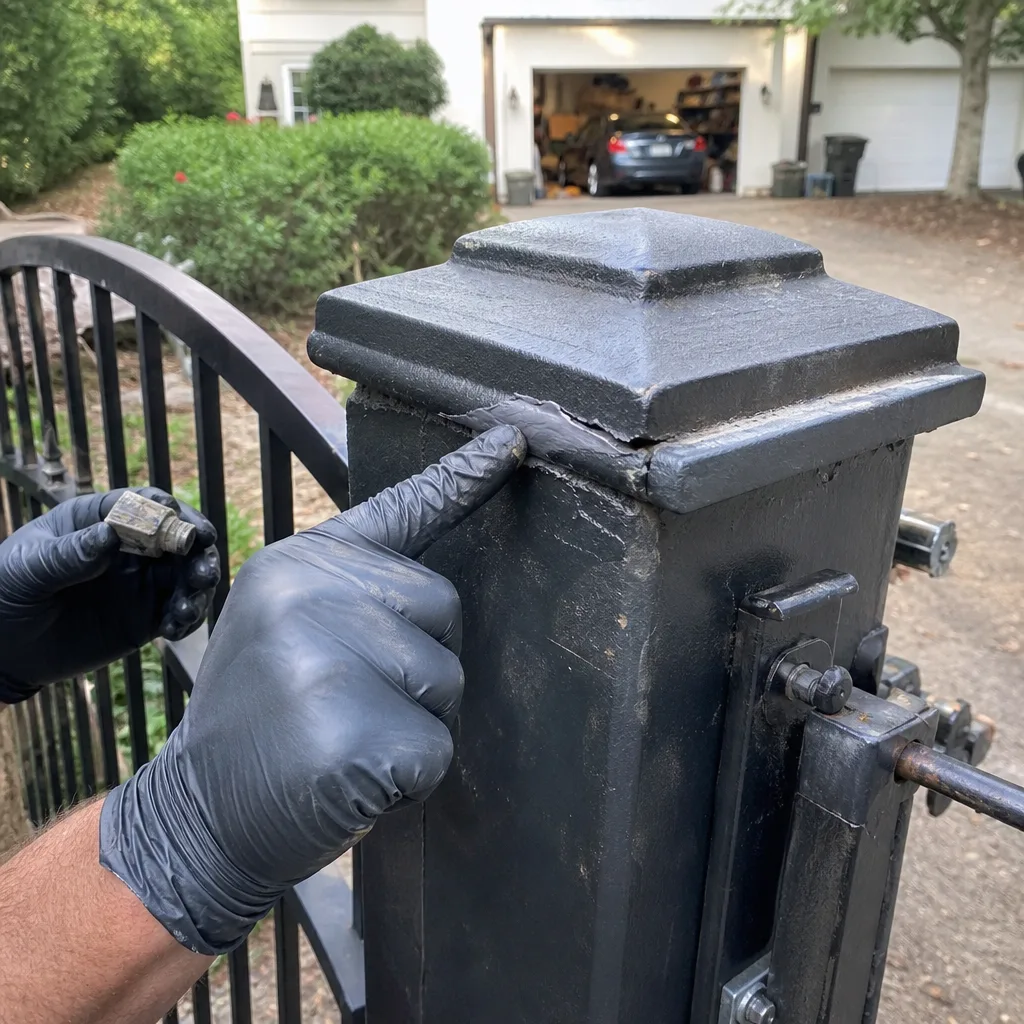
Sound is the most underutilized diagnostic tool homeowners have. These aren’t subjective descriptions; they’re mechanical signatures we’ve correlated to specific failures across thousands of service records.
| Sound | Mechanical Source | Typical Failure Timeline | Component at Risk |
|---|---|---|---|
| Grinding (metal on metal) | Gearbox bearings failed, gears meshing without lubrication | 7-14 days to catastrophic failure | Gearbox, motor |
| Clicking (regular, rhythmic) | Shear pin or drive key partially fractured, catching and releasing | 3-10 days to complete failure | Shear pin, driven gear |
| Relay chatter (rapid clicking from control box) | Control board receiving inconsistent limit switch signal, hunting between states | Intermittent now, progressive | Control board, limit switches |
| Squealing (high-pitched, continuous) | Dry bearings in hinge or roller, metal sliding without grease film | 30-90 days to seizure | Hinge/roller, operator overload |
| Clunking (single, at start or stop) | Loose operator arm bracket, free play before load engagement | 14-45 days to bracket failure | Arm bracket, gate frame |
| Humming without movement | Motor energized, mechanical load not transferred | Immediate - motor overheating risk | Motor, thermal protection |
Relay chatter deserves special attention because it’s frequently misdiagnosed. On FAAC and BFT systems with magnetic limit switches, chatter often means the magnet has shifted on the gate frame and the switch is reading marginally. The control board cycles the relay trying to resolve an ambiguous signal. Left unaddressed, the relay contacts arc and weld, or the board’s output transistor fails from repeated switching.
Electrical Problems That Look Mechanical (and Vice Versa)
This is where homeowner misdiagnosis costs the most money. The symptom points one direction; the cause is opposite.
Gate Stops Mid-Travel: Looks Like Motor, Often Is Limit Switch
A gate that stops dead at the same point every time, or at random points, is frequently reported as “the motor is dying.” In our Sandy Springs records, roughly 40% of these cases are limit-switch drift, not motor failure. The limit switch tells the control board where the gate is. When the switch signal is intermittent or the switch position has shifted, the board loses position reference and stops for safety. The motor is fine. The fix is recalibration or switch replacement, typically $180-$260 versus $600-$900 for motor replacement.
Gate Reverses Randomly: Looks Like Obstruction, Often Is Voltage Sag
On properties with long wire runs from the house to the gate, particularly in the hilly terrain of Sandy Springs where some driveways exceed 200 feet, voltage drop under motor load can cause the control board to reset mid-cycle. When the board reboots, it defaults to a safe state, which may be reverse or stop. The homeowner sees reversal and assumes obstruction. We’ve solved this by installing a dedicated 240V circuit with local step-down, or by upgrading to an operator with higher voltage tolerance.
Sluggish Movement: Looks Like Mechanical Binding, Often Is Failing Capacitor
As noted earlier, start and run capacitors degrade gradually. The gate moves slowly but doesn’t bind at any specific point. Homeowners lubricate hinges, adjust tracks, and tighten chains without effect. A $35 capacitor and 20 minutes of labor resolves what might otherwise lead to complete motor replacement after prolonged overload.
Remote Works Intermittently: Looks Like Receiver, Often Is Antenna Damage
The receiver board is the expensive component, but the antenna is a simple coaxial wire often routed through conduit to the control box exterior. Ground shifts, rodent damage, or UV degradation of the insulation creates intermittent shorts. We’ve found antennas in Sandy Springs properties where the copper braid was corroded green for six inches, creating enough resistance to halve effective range. Antenna replacement: $45-$85. Receiver board: $280-$450.
What to Photograph and Log Before Calling
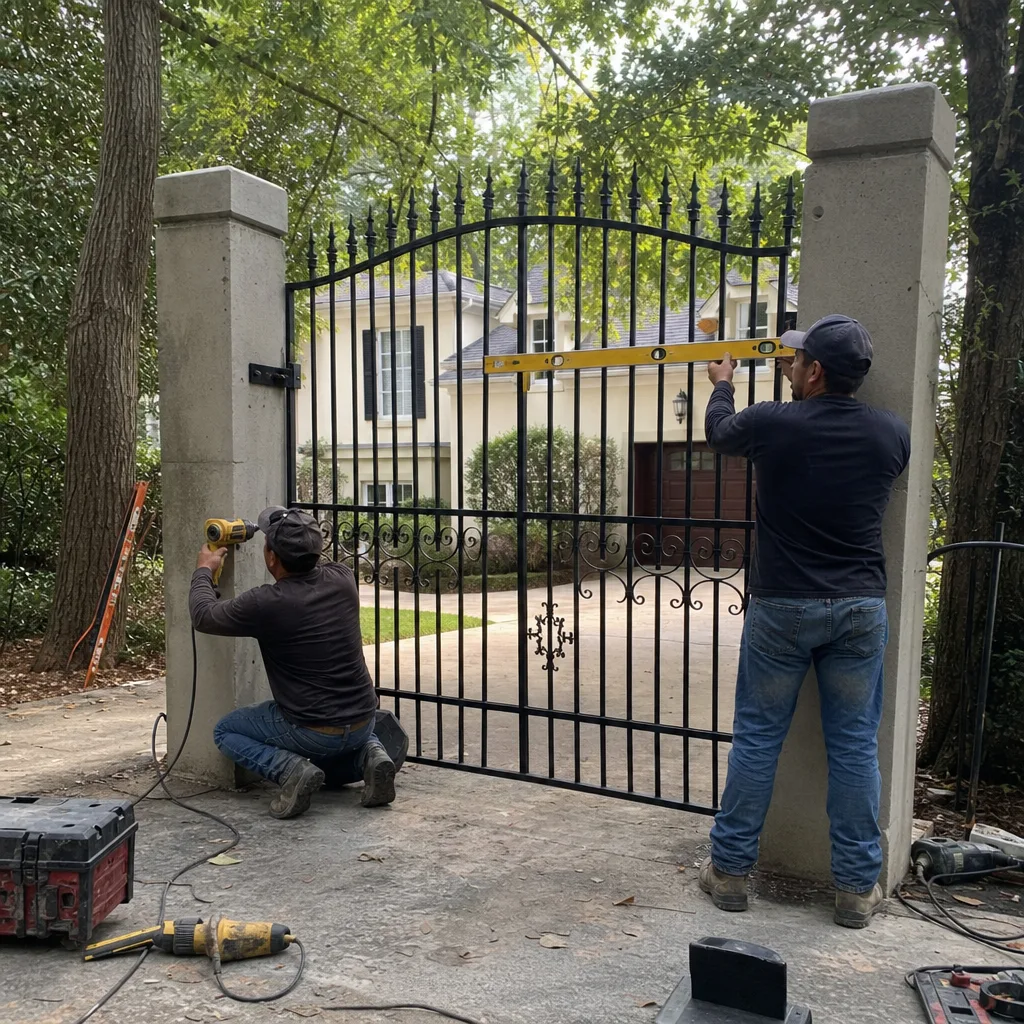
Under Vance Gate Repair Sandy Springs home Haven Standard Clause 4 (Evidence on every job), we document every visit with photos. But the evidence that helps most is often what the homeowner captured before we arrived. A verbal description of “it made a weird noise Tuesday” is less useful than a 10-second video with audio.
- Video the complete cycle. Stand at a fixed position and record one full open and close. Include audio. This captures speed variation, sound signatures, and any visible hesitation or vibration.
- Photograph the control box interior. With power off, open the control box and photograph the wiring terminal block, any LED indicators, and the model/serial number label. On FAAC, BFT, and Elite systems, the diagnostic LED pattern is documented in the manual and correlates to specific faults.
- Photograph the operator arm connection. Show the bracket, bolts, and any visible wear or elongation of mounting holes.
- Photograph hinges and rollers. Look for rust streaking, grease absence, or visible wear patterns.
- Log the timing. Note when the symptom first appeared, whether it’s consistent or intermittent, and whether weather or time of day correlates.
- Record the remote behavior. At what distance does it work? How many presses? Does the keypad behave the same way?
When you call with this information, we can often narrow the probable cause before dispatch and arrive with the correct parts. That saves a return trip and gets your gate documented and repaired in a single visit.
The True Cost of “It’s Still Working”
This rationalization is understandable and expensive. The gate opens. The gate closes. Why spend money?
Because every cycle under abnormal load accelerates wear on every downstream component. A gate with dry hinges that draws 40% excess current doesn’t just risk motor failure. It stresses the control board’s output relays, heats the wiring, fatigues the gearbox, and loosens the masonry anchors that hold the post. We’ve documented repair records where a $220 hinge service call, deferred for three months, became a $1,850 job: motor replacement ($680), control board ($340), gearbox ($280), post reset and re-anchor ($420), plus the original hinge service ($220). The homeowner paid 8.4 times more for waiting.
The Haven Standard exists partly to eliminate this calculus. When we provide a written price before work starts, you know the cost of acting now. The cost of waiting is never written, but it’s predictable from our records. In Sandy Springs, across 22,000+ gates since 2014, deferred maintenance averages 3.2x the original repair cost when finally addressed.
Common Mistakes to Avoid
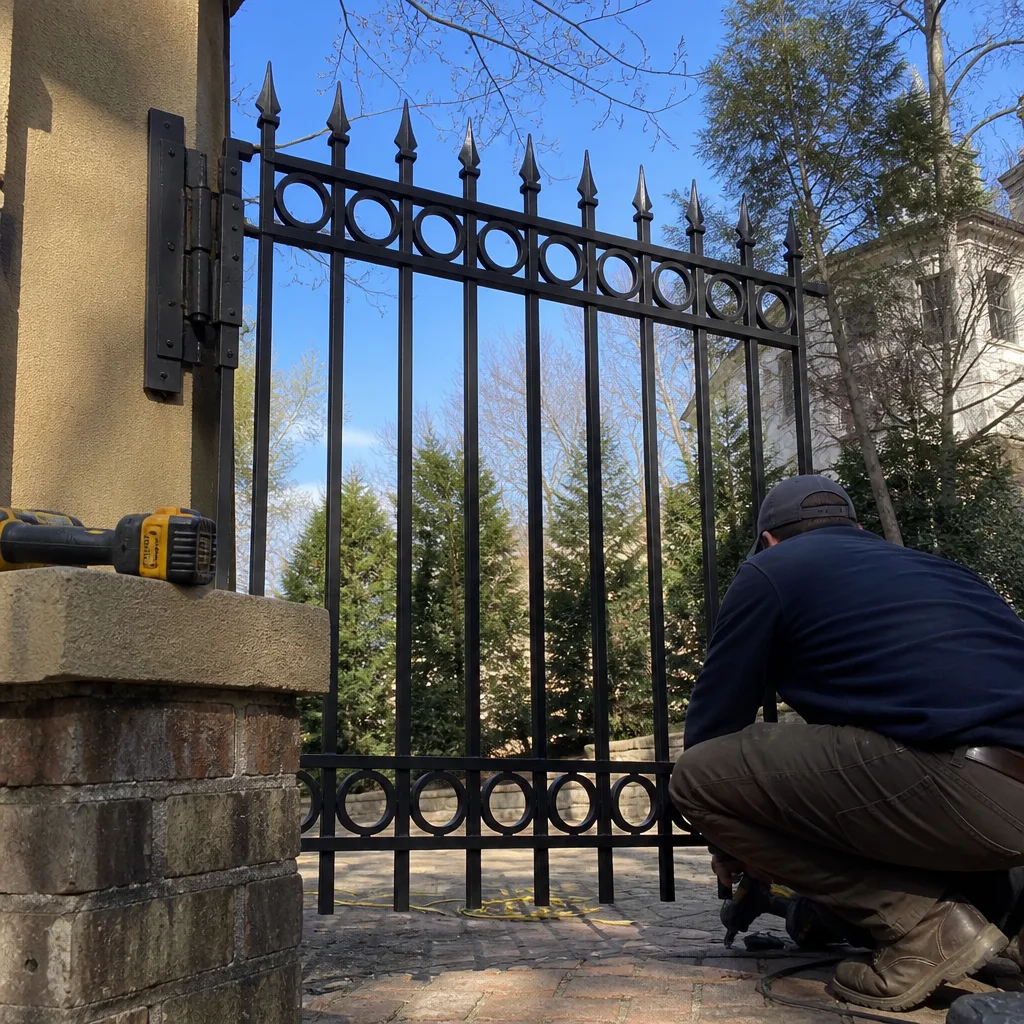
- Applying WD-40 to gate hinges. WD-40 is a solvent and light penetrant, not a lubricant. It displaces existing grease and leaves a residue that attracts dust. Use lithium-based grease or the manufacturer-specified lubricant. We’ve cleaned and re-lubricated hundreds of Sandy Springs gates where WD-40 accelerated wear.
- Adjusting limit switches without understanding travel. Turning the limit switch screws changes where the gate stops, but if the gate’s physical travel has changed (sagging post, bent arm), you’re masking a structural problem. The gate will eventually bind or damage the operator.
- Ignoring post-rain behavior changes. In Sandy Springs clay soils, a gate that acts differently after rain is telling you about ground movement. Addressing it during dry weather misses the causal condition. Document it wet, call when it’s wet or immediately after.
- Replacing the remote battery as the first diagnostic. A weak battery causes consistent reduced range, not intermittent function. If the remote works sometimes and not others, or works from the same distance inconsistently, the problem is not the battery.
- Continuing to cycle a humming operator. This is the single most expensive homeowner action we see. Each cycle of a motor that’s not moving the gate risks thermal damage to windings and control board output failure. Disconnect power and call.
- Accepting a verbal estimate for gate repair. Without written scope and price, you have no record of what was promised. Under Haven Standard Clause 1, we provide both before any work starts. If another company won’t do the same, that is itself a warning sign.
When to Call a Professional
Call when any immediate-stop indicator appears, when a 30-day warning sign persists more than a week, or when you can’t confidently distinguish electrical from mechanical symptoms. For help vetting professionals, see our How to Hire a Gate Repair Contractor in Sandy Springs: A Step-by-Step Guide. Gate operators involve 120V or 240V power, high-tension springs on some swing-gate assist systems, and pinch points that cause serious injury. The control board capacitors retain charge even with power disconnected.
Gate Repair in Sandy Springs from Vance Gate Repair Sandy Springs includes free estimates with written pricing before any work begins. We service nine automation brands - LiftMaster, FAAC, BFT, Linear, Viking, Ghost Controls, DoorKing, Elite, and Mighty Mule - so we repair what’s installed rather than steering you toward replacement. Call (470) 885-1464. A live person answers 24 hours a day, and we dispatch background-checked, uniformed technicians with name and photo provided before arrival.
Frequently Asked Questions
Most gate repairs in Sandy Springs range from $180 for limit-switch recalibration or photo-eye realignment to $680 for motor or control board replacement. Hinge service and lubrication typically runs $220-$340. We provide a written, itemized price before any work starts under Haven Standard Clause 1, and we offer free second opinions on any written estimate from another company. Call (470) 885-1464 for an exact quote on your specific symptom - estimates are free.
Approximately 70% of gate motors we diagnose in Sandy Springs are repairable rather than replaceable. Common repairs include capacitor replacement, gearbox rebuild, limit-switch replacement, and control board repair. We only recommend replacement when the motor casing is cracked, windings are burned, or replacement parts are obsolete for the specific model. Because we service nine brands including LiftMaster, FAAC, and Elite, we can source parts for most systems rather than defaulting to replacement.
Thermal expansion and component drift. In Sandy Springs, summer ambient temperatures above 90°F push control board capacitors and motor insulation toward their rated limits. If components are marginal, they fail under thermal stress. Clay soil expansion from summer moisture also shifts gate posts and tracks. We’ve found that gates with this seasonal pattern typically need control board capacitor replacement and post stabilization before the following summer.
Gate Installation in Sandy Springs from Vance Gate Repair includes: on-site measurement and grade assessment; written material and labor pricing with no deposit required; permit coordination if applicable; post excavation and concrete work; gate fabrication or pre-fab installation; operator mounting and programming; safety device installation (photo-eyes, edge sensors, audible alarm); and a documented photo record of all settings and wiring left with the homeowner. We do not promise same-day installation - this work is measured, ordered, and scheduled properly.
Yes. We run dedicated circuits from your main panel or install a sub-panel near the gate when distance creates voltage-drop concerns. In Sandy Springs, properties with long driveways or hillside lots often require 240V service with local step-down to maintain proper voltage at the operator. This is included in our written scope when needed, with the specific wire gauge and conduit route documented in your job record.
A simple test: try the gate from multiple input devices. If the keypad, remote, and vehicle sensor all produce the same symptom, the problem is downstream of the control logic - motor, gearbox, or mechanical. If one input works and another doesn’t, the problem is in the access control wiring or device. Gate Motor & Opener in Sandy Springs diagnostics from Vance Gate Repair include testing all input paths and documenting which produce normal versus abnormal response. Call (470) 885-1464 to schedule - estimates are free.
The Bottom Line
Gate failure is rarely sudden. It’s documented in startup delays, sound changes, and post-rain behavior shifts that most homeowners rationalize until the gate stops entirely. This guide gives you the timeline: immediate-stop indicators mean call today, 30-day warning signs mean call this month, slow-decay patterns mean plan and budget now. For more guides & resources on maintaining your gate system, visit our blog. The specific sounds, the electrical-mechanical misdirections, and the documentation steps let you participate in the diagnostic process rather than passively wait for failure.
In Sandy Springs, where terrain, soil, and climate stress gate systems in predictable ways, early intervention based on documented symptoms saves an average of 60-70% versus emergency repair. Under the Haven Standard, every Vance Gate Repair visit leaves you with a written price before work starts, a photographic record of what was found and what was done, and the 365-Day Done Right Promise covering all completed work.
Written by Adrian Vance, Owner at Vance Gate Repair Sandy Springs, serving Sandy Springs since 2014.